Henry Dearborn's allegations against Israel Putnam collapse under scrutiny –
contradicted by Washington's own words, by Dearborn's private journals, by the
testimony of contemporaries, and by the most basic rules of evidence and logic.
The Commander's Verdict
Washington appointed Putnam Senior Major General just three weeks after Bunker Hill, making him second-in-command of all American forces.
On June 2, 1783, as the Revolutionary War drew to a close, George Washington wrote a personal
letter to Israel Putnam. It is Washington's permanent record of where Putnam stood among the
great officers of the Revolution – written eight years after Bunker Hill, by the man who had
commanded the Continental Army throughout the entire war.
Among the many worthy & meritorious Officers with whom I have had the happiness to be
connected in Service through the Course of this War, and from whose chearfull Assistance
& Advice I have received much support & Confidence in the various & trying
Vicissitudes of a Complicated Contest, the Name of a Putnam is not forgotten; nor will it
be, but with that Stroke of Time which shall obliterate from my Mind the Remembrance of
all those Toils & Fatigues through which we have struggled for the preservation &
Establishment of the Rights, Liberties & Independance of our Country.
George Washington to Israel Putnam, June 2, 1783 – DLC: Papers of George Washington
Washington places Putnam explicitly among the officers from whose "chearfull Assistance & Advice"
he "received much support & Confidence" through the "various & trying Vicissitudes" of
the war. This is not a courtesy letter. It is a considered tribute, written by a man who spent
eight years evaluating the conduct of his officers under fire, to one he regarded as among the
most meritorious of them all.
Consider what Washington is saying. He had appointed Putnam Senior Major General – second-in-command
of the entire Continental Army – just three weeks after Bunker Hill. He had relied on him through
the darkest years of the conflict, including the desperate campaigns of 1776 and 1777. He had
entrusted him with the defense of New York, the Hudson Highlands, and the winter encampment at
Princeton. Through all of it, Washington's confidence never wavered.
No allegation published 35 years later by a man who rose to prominence under Putnam's command
and never once recorded a whisper of complaint – whose own War of 1812 command ended in recall,
and whose subsequent Cabinet nomination was rejected by the Senate – can outweigh this verdict.
The Silence of Six Journals
Henry Dearborn was an unusually diligent diarist. He maintained six separate journals
that exhaustively chronicled his experiences throughout the Revolutionary War.
Not one of these journals contains a single word suggesting that Israel Putnam behaved improperly
at Bunker Hill – or at any other engagement.
This is not a minor omission. Dearborn was present at the battle. If he had witnessed the
cowardice he would later describe in such vivid detail – a general hiding on a hill 600 yards from
the fighting for the entire engagement – the natural moment to record it was in the journals he
kept during the war, not 43 years later in a political pamphlet timed to a gubernatorial campaign.
The journals survive. The allegation does not appear in them.
The implications are straightforward. Either Dearborn did not witness what he later claimed, or
he did not consider it worth recording at the time – which strains credibility if the conduct
was as egregious as he later described. The 43-year silence that separates the battle from the allegation
is not explained by forgetfulness. It is explained by the fact that Dearborn had no political
incentive to fabricate the story until 1818.
This I do say without reserve, I never heard the least insinuation of dissatisfaction
with the conduct of General Putnam during his whole life; and had the characters of
Generals Greene, Knox, La Fayette, or even Generals Warren, Montgomery, or Mercer,
been called in question, it would not have surprised me more.1
President John Adams to Daniel Putnam, 5 June 1818.
Adams was at the center of revolutionary decision-making for the entire period in question. He
had personally voted to appoint Putnam Major General. He had never – in 43 years – heard a
whisper of dissatisfaction with Putnam's conduct. He placed Putnam's reputation in the company
of Greene, Knox, and Lafayette – the most revered officers of the Revolution – and expressed
astonishment that anyone would question it.
A Witness to His Own Guilt
Dearborn's allegation contains a logical contradiction that has never received the attention it
deserves. He claims that Putnam "remained at or near the top of Bunker Hill" for the entire
battle – 600 yards behind the fighting. How could he have known this?
The only ways Dearborn could have been aware of Putnam's position throughout the engagement are:
First – he was himself on or near Bunker Hill, watching Putnam, for a substantial
portion of the battle. In that case, Dearborn was himself "skulking" from the fighting – the very
charge he leveled at Putnam – and his account of a coward is the testimony of a coward.
Second – he is relying on the account of a third party who was on or near Bunker
Hill and watching Putnam. In that case, his source was also avoiding the fighting, his account
is hearsay, and the unnamed witness was engaged in the same conduct Dearborn found so reprehensible
in Putnam.
There is no third option. Dearborn either condemns himself as a witness or condemns the reliability
of his source. In either case, the allegation cannot stand.
Bunker Hill Was Not a Safe Haven
Dearborn's allegation presupposes that the top of Bunker Hill – 600 yards behind the main
fighting at the redoubt – was a place of safety, a refuge for a coward. The historical record
shows this is false.
Increase Tarbox, in his authoritative biography of Israel Putnam (1876), addressed this directly,
drawing on the testimony of Captain John Chester:
If General Putnam had kept that position on the top of Bunker Hill, after the British lines
came up and began their firing, his chances of being killed would have been at least ten times
greater than though he had been in the redoubt. It is a notorious fact in this battle, that
the British fired over the heads of our men who were in the front of the fight. Captain Chester
has just told us how the cannon and musket shot whistled past him, from the moment he reached
the top of Bunker Hill and began to descend. It was a very poor place for a coward to take
refuge. The men who really kept out of danger were over on the back side of the hill, and
around the neck. General Dearborn, therefore, when he brought his calumnious charges against
General Putnam for cowardice, fixed upon an exceedingly undesirable place for a coward to
tarry in order to keep out of danger.
Increase Tarbox, Life of Israel Putnam, 1876 (pp. 178–179).2
Tarbox continues, turning Dearborn's own words against him:
General Dearborn says, "He [Putnam] remained at or near the top of Bunker Hill until the
retreat." If he did so, as we have before suggested, he occupied a very dangerous position,
for we will take from this same article of his a passage descriptive of the British style
of firing. He says, "The fire of the enemy was so badly directed, I should presume that
forty-nine balls out of fifty passed from one to six feet over our heads." Now, though the
balls going in that manner, at the point where Dearborn was, would not have reached the top
of Bunker Hill, but would have lodged in its sides, yet farther to the left, toward the
redoubt, where the ground was much higher, such firing as that from those British muskets
would have rendered a man extremely liable to accidents "at or near the top of Bunker Hill."
Colonel Swett, in his history of the battle, speaks of the top of Bunker Hill in these words:
"The battle indeed appeared here in all its horrors. The British musketry fired high and took
effect on this elevated hill, and it was completely exposed to the combined fire from their
ships, batteries and field pieces."
Increase Tarbox, Life of Israel Putnam, 1876 (pp. 257–258).3
Dearborn's own description of the British rate of fire – 49 out of 50 balls passing over the
heads of men at the redoubt – demolishes his premise. Those balls did not disappear. They
continued uphill. The "place of safety" Dearborn described was, by his own account, one of the
most exposed positions on the field.
The Verdict of History in Art
In the summer and autumn of 1775 – within weeks of the battle, while hundreds of eyewitnesses
were still alive – two independent pictures of the Battle of Bunker Hill were published. Both
identify Israel Putnam, by name, as the commanding officer of the American forces.
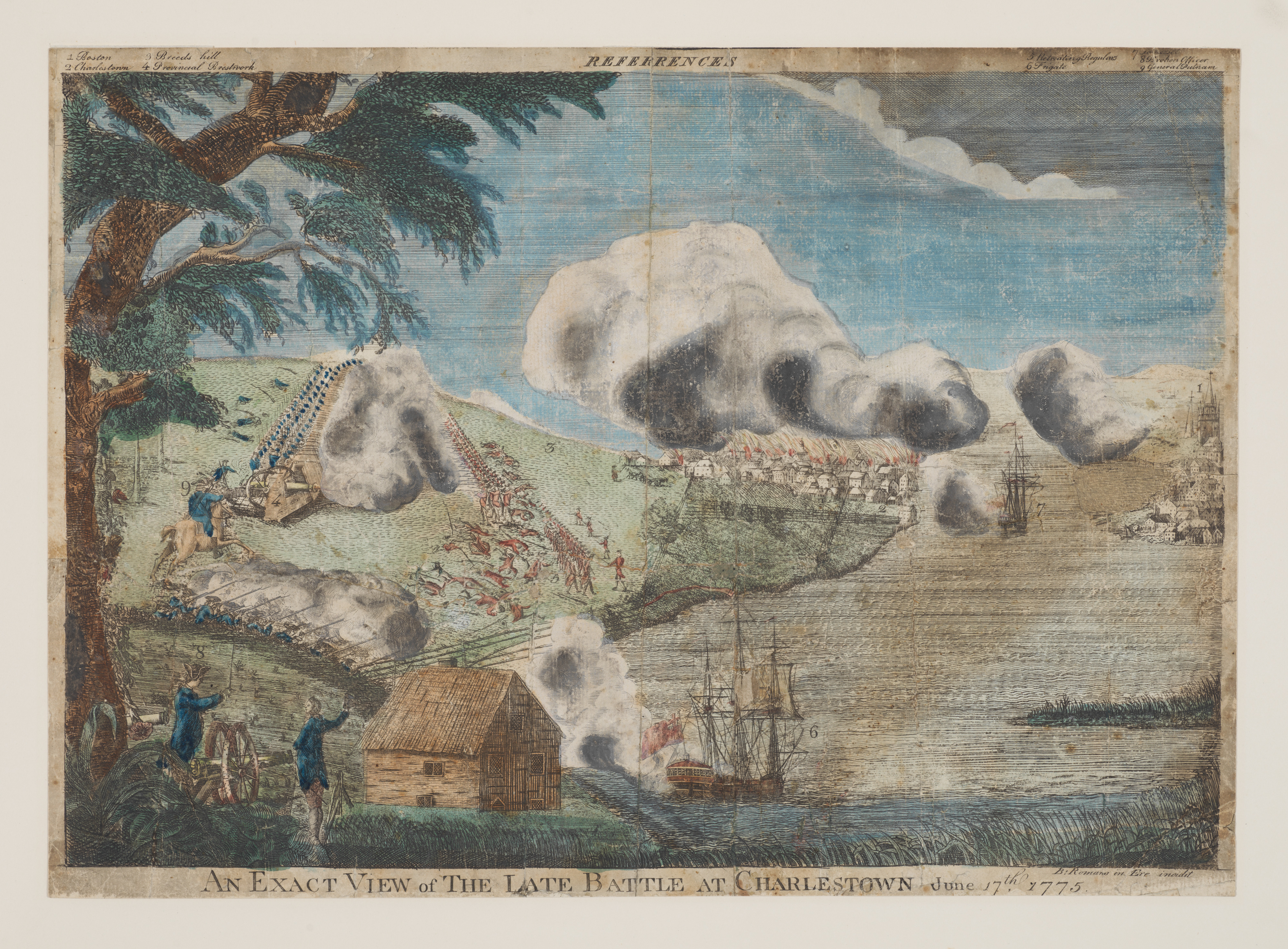
The first was published in The Pennsylvania Magazine in July 1775. The Continental
Congress was sitting in Philadelphia, and information about the battle had reached the city
within days. The picture was accompanied by a key identifying nine points of interest. Of all
the officers present at the battle, only one is named: "(9) General Putnam."
He appears on his white horse, sword drawn, in the attitude of command. Prescott is not named
or indicated anywhere in the picture.
An Exact View of the Late Battle at Charlestown, June 17th, 1775. Engraving after Bernard Romans, published in The Pennsylvania Magazine, July 1775. The key identifies nine features; only one officer is named: "(9) General Putnam." Metropolitan Museum of Art. Public domain.
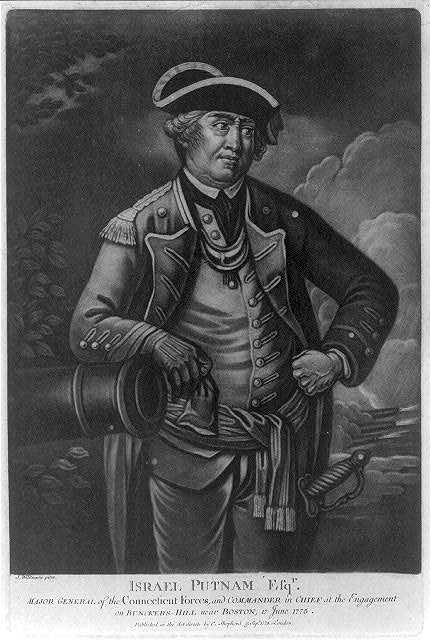
The second was published in London in September 1775 – by an artist who signed as J. Wilkinson
and a publisher identified as C. Shepherd. It bears the following inscription:
Israel Putnam, Esq., Major-General of the Connecticut forces, and commander-in-chief at the
engagement on Bunker Hill near Boston, 17th June, 1775.
J. Wilkinson / C. Shepherd, London, September 1775
Mezzotint portrait of Israel Putnam. Engraved by J. Wilkinson, published by C. Shepherd, London, September 1775. Inscription reads: "Israel Putnam, Esq., Major-General of the Connecticut forces, and commander-in-chief at the engagement on Bunker Hill near Boston, 17th June, 1775." Library of Congress. Public domain.
This is the British testimony – published in England, where the battle was of intense public
interest, just months after it occurred. British officers who had fought at Bunker Hill were
in London. British sympathizers with the American cause, who followed the war closely, were
in London. The picture that emerged from this environment identified Putnam – not Prescott –
as the commander.
As Increase Tarbox observed of these two pictures:
In these two pictures we have the American testimony on the one hand, and the British
testimony on the other, both exactly concurring, uttered in the plainest manner, in the
summer of 1775. And is there one particle of historical evidence, that in those years
nearest to the battle, when living men in great numbers knew the facts, any writer ever
objected to those two pictures as bearing false witness?
Washington's first general order after taking command of the Continental Army – issued July 7,
1775, three weeks after Bunker Hill – cashiered an officer for cowardice at that very battle.
Captain John Callender of Colonel Richard Gridley's Massachusetts artillery regiment had been
court-martialed on June 27 for cowardice and disobedience of orders. Washington approved
the sentence, writing that cowardice was "A Crime of all others, the most infamous in a
Soldier, the most injurious to an Army, and the last to be forgiven."
Putnam himself drove the prosecution. The editorial annotation to Washington's July 7 order
in the Founders Online edition records that Putnam declared the defeat at Bunker Hill was
owing to "the ill-behaviour of those that conducted the artillery," and demanded Callender
be cashiered or shot.5
The implication is direct. In July 1775, Putnam was personally pressing the Continental Army's
accountability system to prosecute cowardice at Bunker Hill. The system responded – it cashiered
Callender. At the same time, Washington promoted Putnam to Senior Major General,
second-in-command of the entire Continental Army.
These two facts are difficult to reconcile with Dearborn's account. A commander who had himself
behaved as a coward at Bunker Hill is unlikely to have demanded prosecution of others for that charge.
A commanding general who had witnessed such conduct would not have promoted the man responsible
to the second-highest position in the army.
Affirmative Testimony vs. Passive Denials
Common-law evidentiary tradition recognizes a meaningful distinction between affirmative and
negative testimony. Saying you saw something is materially stronger evidence than saying you
were present and did not see something. Affirmative testimony describes a specific observation;
negative testimony describes only an absence – and absences can result from inattention,
limited vantage, the chaos of battle, or any number of factors having nothing to do with
whether the thing in question occurred.
Dearborn's central claim is negative: he did not see Putnam at the lines. The majority of
his supporting witnesses use the same form – they did not see Putnam at the redoubt, or here,
or there. Not seeing a mounted general officer in the smoke and confusion of an eighteenth-century
military engagement is not inconsistent with that officer having been present.
The affirmative side of the record is a different matter. Multiple sworn witnesses placed
Putnam mounted on horseback and actively engaged throughout the battle. Philip Johnson of
Colonel Little's regiment, in a deposition published in Samuel Swett's history of the battle,
placed Putnam mounted at the rail fence before the action. Simeon Noyes stated that Putnam
"was not in the fort during the engagement; he was riding to and fro in all parts of the line,
encouraging the men." Benjamin Pierce – who served in Dearborn's own regiment – saw Putnam
on a horse "covered with lather produced by constant, feverish exertion" and stated Putnam
was "as brave as any man" in the battle.6
These accounts are specific, affirmative, and independent of one another. They describe a mounted officer
moving continuously along the American line – visible, identifiable, and under fire. The
affirmative testimony stands; the negative testimony cannot serve to rebut it.
Putnam at Charlestown Neck
Among the contemporary 1818 accounts of the battle, Samuel Swett's Historical and
Topographical Sketch of Bunker Hill Battle – published as an appendix to the 1818 reprint
of Humphreys's biography of Putnam, addressed to the State Society of the Cincinnati in
Connecticut – preserves a passage that goes directly to the geography of Dearborn's allegation.
Swett describes Putnam personally driving reinforcements across Charlestown Neck under
sustained British fire:
Putnam flew to the spot to overcome their fears and hurry them on before the enemy returned.
He entreated, threatened, and encouraged them; lashing his horse with the flat of his sword,
he rode backward and forward across the Neck, through the hottest fire, to convince them
there was no danger. The balls, however, threw up clouds of dust about him, and the soldiers
were perfectly convinced that he was invulnerable, but not equally conscious of being so
themselves.
Samuel Swett, Historical and Topographical Sketch of Bunker Hill Battle, 1818.7
The two accounts cannot both be true. Dearborn places Putnam at or near the top of Bunker Hill
for the duration of the action – 600 yards behind the lines, by his own account. Swett places
Putnam mounted at Charlestown Neck, riding through canister fire, conspicuously exposing
himself to British artillery in a deliberate effort to shame reinforcements forward to the battle. The
geography is incompatible: Putnam cannot have been simultaneously sheltering on Bunker Hill
and charging back and forth across the Neck. One account describes the conduct of a coward;
the other describes the conduct of a heroic officer, blind to personal danger, driving terrified men into a battle they were
trying to avoid.
Swett's account is not a remote one. He was writing within months of Dearborn's Port Folio
piece, drawing on documents collected in defense of Putnam's reputation that were deposited in
the Boston Athenaeum (and have since been lost). His sketch was published as the appendix to
Humphreys's biography – the biography Washington helped prepare at Mount Vernon and edited
before publication. The Swett-Humphreys volume is, in effect, the formal 1818 reply to Dearborn
from the side of Washington's circle.
The Dearborn Paradox
For Dearborn to have known that Putnam was 600 yards back on Bunker Hill, Dearborn
would have had to be in a position to see him there.
Dearborn's own account places him at the right end of the rail fence, preparing for hand-to-hand combat
with British infantry advancing along the Mystic River beach. That position and
the top of Bunker Hill are separated by approximately 600 yards of contested ground, complete with smoke, chaos, and the general confusion of a battle in which over a thousand men were killed or wounded.
He cannot simultaneously have been (a) engaged in close fighting at the rail fence and
(b) in a position to observe Putnam's location 600 yards behind the lines for the duration
of the engagement. After all, he did not have the benefit of closed-circuit television. To claim knowledge of Putnam's position throughout the battle, Dearborn
would have had to absent himself from the point of danger for a substantial portion of the action –
which is precisely the conduct he attributed to Putnam.
The same logic applies to most of his supporting witnesses. A soldier who can testify
that Putnam was not at the redoubt or at the rail fence has unwittingly disclosed something about
his own conduct during the battle. In each case, the witness claims to have been
somewhere other than where the fighting was concentrated. In addition, their evidence is negative;
their vantage was limited; and their authority to speak to Putnam's whereabouts across
the entire field is open to question on its own terms.
The Strongest Case Against Putnam
A credible defense of the historical record requires engaging the opposing case on its
strongest terms.
The Allegation, Stated Fairly
Henry Dearborn was a participant in the battle, serving under Colonel John Stark near
the right end of the rail fence – a position of genuine danger, from which he had direct
experience of the engagement. His 1818 account was published in The Port Folio,
a reputable periodical. He was not an anonymous pamphleteer.
His account was corroborated by sworn affidavits. The Reverend Daniel Chaplin of Groton
and the Reverend John Bullard of Pepperell, deposing on June 5, 1818, reported that their parishioners stated Colonel Prescott had confronted Putnam after the redoubt fell and asked why he had not
brought up reinforcements. Putnam's reported answer – "I could not drive the dogs up" –
and Prescott's reply – "If you could not drive them up, you might have led them up" –
appear in their account. Abel Parker of Jaffrey, New Hampshire, a veteran of Prescott's
unit, stated he had never read any account of the battle he considered correct until
Dearborn's. The allegation is consistent in form across multiple depositions.8
No documentary response from Putnam himself survives – he died in 1790, 28 years before
the allegation was published. And modern historiography, including the Encyclopaedia
Britannica, has accepted the broader assessment that while Putnam was a brave and
energetic officer, he may not have been fully equal to the generalship his wartime
popularity brought him.
The Response
This case rests on several weaknesses that, taken together, are decisive.
The 43-year delay has no adequate explanation. Dearborn kept six journals throughout the
Revolutionary War. None contain a word about Putnam's conduct at Bunker Hill. He had
both the opportunity and the documented habit of recording what he observed. The allegation
appears for the first time in 1818 – in the same year as two consecutive gubernatorial
campaigns against a Bunker Hill veteran, and 28 years after Putnam's death made a response
impossible. The timing is not coincidental.
The institutional context matters. As documented on the Political Context page,
Dearborn's son became a founding member of the Bunker Hill Memorial Association five years
later and spent decades shaping the monument's narrative, a narrative conceived by master propagandist Samuel Adams' September 26, 1775 letter to Elbridge Gerry. The allegation did not stand on
its own merits; it was institutionally reinforced over generations by men with an interest
in its survival.
Finally, a clarification that the Chaplin-Bullard account itself makes necessary: the
exchange attributed to Prescott and Putnam – whatever its source – is not evidence of
cowardice. A commander who could not move reinforcements forward, in a battle where the
retreat was already beginning, was confronting a problem of command in chaos, not an
act of personal cowardice. Most of the troops present were Massachusetts militiamen who did not recognize the authority of Israel Putnam, a Connecticut general. The two questions are distinct. This site's claim is specific:
that Israel Putnam was not a coward, but a hero, at Bunker Hill. His broader qualities as a general
officer are a separate subject.