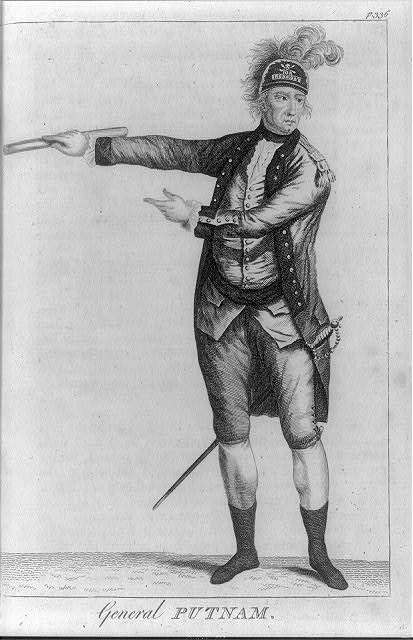
"General Putnam," engraving, 1780. Library of Congress. Public domain.
The modern case against Putnam originates with Henry Dearborn's 1818 allegations, published 43 years after the battle and 28 years after Putnam's death. Below are the 9 central claims – and the primary source evidence that contradicts each one.
"General Putnam," engraving, 1780. Library of Congress. Public domain.
This is Dearborn's central claim – and it is directly contradicted by members of his own regiment. Abel Parker and Benjamin Pierce, both serving under Dearborn, testified under oath that they saw Putnam at the redoubt and rail fence during the battle.
Furthermore, multiple accounts confirm that Bunker Hill was under heavy fire throughout the engagement. Colonel Swett's history records that the top of Bunker Hill "was completely exposed to the combined fire from their ships, batteries and field pieces." It was no safe refuge.
As Daniel Webster observed: "If those who knew General Putnam's behavior at that time found no fault with it, the presumption is, that no fault could be found with it."
One of the most glaring distortions in the historical record involves a claim not central to Dearborn's charges of cowardice: it concerns Massachusetts Colonel William Prescott, the patriot commander of the redoubt at Breed's Hill.
As detailed in the Political Context section, Prescott was elevated to the role of the battle's hero long after the fact — displacing Israel Putnam, the universally recognized hero of the day — at the urging of Massachusetts partisans, beginning with master propagandist Samuel Adams, to draw attention away from the conduct of Massachusetts officers and the charge that they bore responsibility for the American defeat.
That same distortion extends to the famous command, "Don't fire 'til you see the whites of their eyes," now popularly attributed to Prescott though no eyewitness ever credited it to him. As the Political Context section and the sworn statements collected on this site show, several eyewitnesses instead credit that command to Israel Putnam.
Multiple eyewitnesses confirmed hearing this order from Putnam directly. Philip Johnson, who was at the rail fence, heard it firsthand. This was not a single momentary utterance but a command repeated along the lines to conserve precious ammunition.
Notably, not one eyewitness ever claimed to hear Prescott give this order. By contrast, numerous named witnesses signed sworn affidavits stating they heard it from Putnam.
This is perhaps Dearborn's most easily disproven claim. Multiple witnesses – including Dearborn's own regimental comrade Benjamin Pierce – testified they saw Putnam on his white horse during the battle. Pierce specifically noted the horse was "covered with lather produced by constant, feverish exertion" as Putnam rode between positions.
Colonel Wade of Little's Regiment stated plainly: "He was the only officer I saw on horseback." Simeon Noyes described Putnam on "his old white horse," riding "to and fro in all parts of the line."
Dearborn's claim rests on negative evidence – he did not personally see anyone mounted. The sworn testimony of numerous eyewitnesses who did see Putnam on horseback cannot be dismissed by one man's failure to observe it.
The eyewitness record credits Putnam with directing defenses, extending the American line to the Mystic River via the rail fence, and actively commanding Connecticut troops at the fence throughout the engagement.
Ezra Runnels of Gridley's Artillery testified that Putnam personally loaded cannons with a ladle after finding cartridges too large for the pieces. Joshua Yeomans watched Putnam load a cannon with musket balls from his saddlebag and fire at British officers. Alexander Davidson saw Putnam accompany field pieces to the rail fence and oversee their placement and firing.
The rail fence position – under Putnam's direct command – was the most successful sector of the American line, repulsing two British attacks and inflicting enormous casualties.
The letter in question was written by John Trumbull – the military artist who was present at Bunker Hill and later painted the famous battle scene. After reading Dearborn's Port Folio piece, Trumbull wrote to Daniel Putnam, the General's son, in defense of his father's character. The letter was published in Daniel Putnam's 1818 Munroe & Francis pamphlet alongside sworn affidavits from eyewitnesses.
Trumbull expressed regret over the accusations and reported that British Colonel John Small – Putnam's friend from the French and Indian War – had personally confirmed that Putnam was at the rail fence during the battle and had saved Small's life there by ordering nearby colonial soldiers not to fire on him. This account, from a British officer with no stake in the American political dispute, places Putnam precisely where Dearborn claimed he was not.
Modern repetitions of Dearborn's narrative cite several additional figures. A closer examination of what they actually said reveals a pattern: their testimony either fails to support the allegations or actively contradicts them.
Their statements were hearsay – "some of our parishioners told us." They were not eyewitnesses to the battle. Notably omitted from modern accounts is their observation that "Putnam and Prescott were on terms of respectful friendship as long as they lived" – an odd detail if Putnam had truly abandoned the field.
Stark's own regiment contained multiple soldiers who testified they saw Putnam at the rail fence – the very position adjacent to Stark's command. Reuben Kemp, Richard Gilchrist, Samuel Bassett, and Ebenezer Bean, all of Stark's regiment, placed Putnam at the rail fence giving orders and threatening deserters.
If Stark "proceeded to the rail fence in full view of Putnam," as the modern narrative concedes, this directly contradicts the claim that Putnam never left Bunker Hill.
Wilkinson was not at Bunker Hill. He joined the army later as an 18-year-old medical student. His statement was secondhand: "I understand from high authority..." Even this hearsay placed Putnam on Bunker Hill during the battle – not hiding from it. Hearsay from a man who wasn't there cannot override 63 sworn testimonies from men who were.
Heath called Putnam a "respected general officer" and noted the army was "significantly reinforced and strengthened by the arrival of Putnam from Connecticut in June, 1775, precisely when the Battle of Bunker Hill was waged." This is an endorsement, not a criticism.
A consistent pattern emerges across all nine claims: Dearborn's own witnesses contradict his central allegations. Pierce saw Putnam on a horse. Parker saw Putnam at the redoubt. Stark's men saw Putnam at the rail fence. Even Wilkinson's hearsay placed Putnam at the battle. The supporting witnesses either fail to support the case or actively undermine it.
This is the evidentiary foundation upon which the case against Putnam rests – and it collapses under the weight.
This I do say without reserve, I never heard the least insinuation of dissatisfaction with the conduct of General Putnam during his whole life; and had the characters of Generals Greene, Knox, La Fayette, or even Generals Warren, Montgomery, or Mercer, been called in question, it would not have surprised me more.President John Adams, 1818