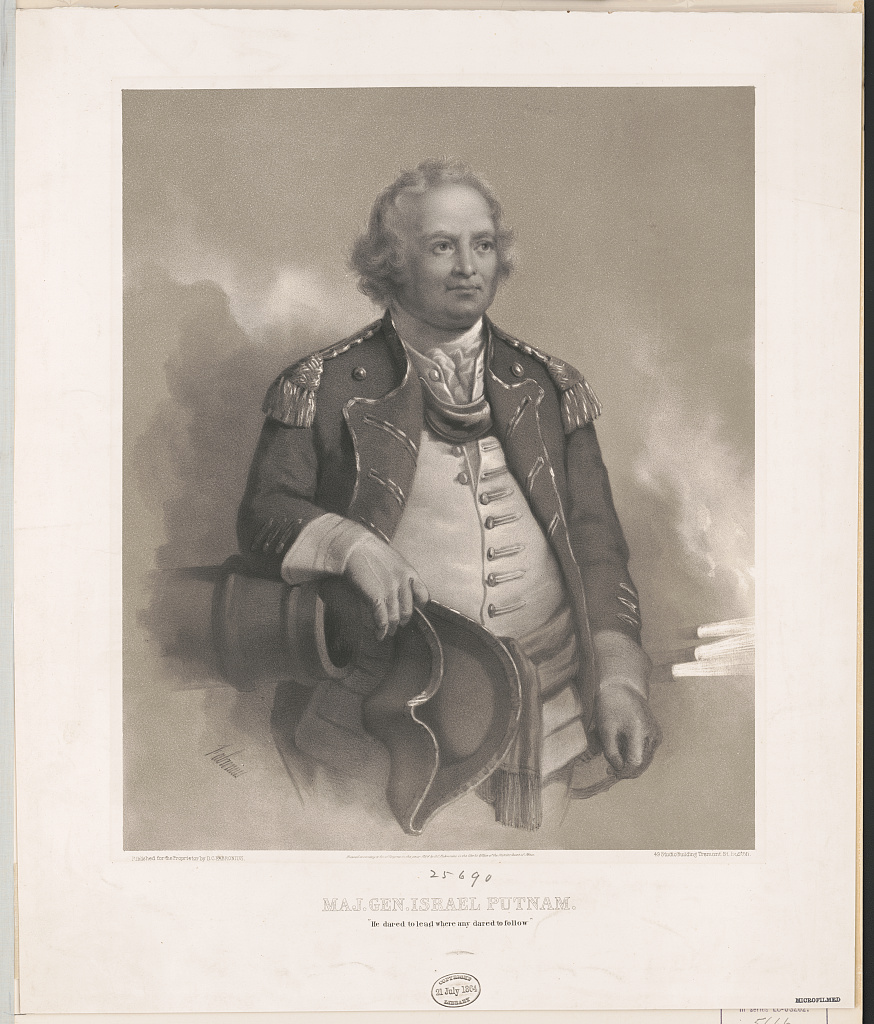
Maj. Gen. Israel Putnam, by D.C. Fabronius, c. 1864. Library of Congress.
The true story of a Revolutionary War hero, the smear campaign initiated, for the first time, against him 43 years after the battle, and the mountain of evidence that puts the lie to it – once and for all.
Maj. Gen. Israel Putnam, by D.C. Fabronius, c. 1864. Library of Congress.
Was Israel Putnam the hero of the Battle of Bunker Hill, famously ordering his men, "Don't fire 'til you see the whites of their eyes?" Or was he a skulking coward, who ran away to safety on a hill several hundred yards away from the fighting where he spent the entire battle?
Henry Dearborn and His Modern Acolytes
Dearborn was a young New Hampshire captain at the battle. In 1818, 43 years after the battle,1 he claimed for the first time that Israel Putnam – far from being the unrivaled hero – actually acted the part of a coward, hiding from danger on far away Bunker Hill (the battle was fought on Breed's Hill; Bunker Hill stood several hundred yards behind it toward the Charlestown Neck) for the entire battle.
Putnam had been enshrined in the national consciousness as perhaps the greatest military hero of the revolution, second only to Washington. Dearborn's revisionist narrative jostled everything Americans thought they knew about the founding of their country.
Questions immediately arose as to why Dearborn had not reported the cowardice of a man who ascended to the highest echelons of American military power shortly after the battle. Instead, he waited until Putnam was safely in his grave and unable to defend himself – which many interpreted to be the real act of cowardice in this story.
The allegations, published seven years before the 50th anniversary of the battle, touched off a public controversy that continued for three decades. Dearborn's account was contested immediately and vigorously by surviving veterans and public figures, and his reputation never recovered.
George Washington
The evidentiary case against Putnam has never been strong. It consists of a single accusation, published in The Port Folio in 1818 – forty-three years after the battle, twenty-eight years after Putnam's death – by a man whose own gubernatorial campaign had failed against a Bunker Hill veteran the year before. No contemporaneous record corroborates it; Dearborn's six surviving wartime journals contain not a syllable on the matter.
The record on the other side is substantial. Sixty-three sworn affidavits2 – including from soldiers in Dearborn's own regiment – place Putnam mounted, and leading the defense while under fire across the American line. Two independent prints published within months of the battle, one in Philadelphia in July 1775 and one in London that September, identify Putnam by name as the commander. Within three weeks of the engagement, Washington presented him with a commission as Senior Major General – issued days after Washington had cashiered an artillery officer for cowardice at the very same battle.
The figures who came forward in Putnam's defense were not minor. Former President John Adams placed Putnam in the company of Greene, Knox, and Lafayette and stated he had never heard a whisper against his conduct. Daniel Webster, in the North American Review, called Dearborn's behavior a breach of "common decency." John Trumbull – the painter who observed the battle as a military artist – wrote in defense of Putnam, confirming Putnam's presence at the rail fence during the second assault — where he saved the life of British Colonel John Small — not at the redoubt. Massachusetts Governor John Brooks, himself a Bunker Hill veteran and the man who had twice defeated Dearborn at the polls for governor, toured the battlefield personally to demonstrate the folly of Dearborn's account.
The evidence has always been available. This site presents it systematically – primary source by primary source, against the specific claims made – so that readers can weigh it for themselves.
The reader's indulgence is requested as some background information is necessary: Washington had been appointed Commander in Chief at a session of the Continental Congress in Philadelphia on June 1775, after which he immediately left for Boston to take command of the Continental Army. He carried with him the commissions of four major generals – Artemas Ward of Massachusetts, Charles Lee, Philip Schuyler and Israel Putnam, in that order. Besides Washington himself, Putnam was the only unanimous selection among them.
It was while Washington was en route to Boston that the Battle of Bunker Hill took place on June 17, 1775. Upon his arrival, he took command on July 3, and immediately convened courts martial to examine allegations of misconduct against several officers during the recent battle. Washington was obviously intensely interested in the conduct of the officers that he would be responsible for selecting to the most important positions in the Continental Army in the coming war against the mighty British Empire.
One of Washington's first acts was to present Israel Putnam's major general commission, making him second in command in the entire army. This obviously exposed Washington to bitter recrimination, since Putnam replaced Artemas Ward of Massachusetts as senior major general. Washington had been thoroughly apprised of Ward's lethargic performance during the battle, which likely caused the American defeat. Ward had 20,000 soldiers available, mostly Massachusetts men, but provided only 200 reinforcements immediately before the battle started. Ward was stripped of all decision making authority for the balance of the war, and promptly resigned.
By making Putnam senior major general and second in command to Washington himself, the commander in chief bestowed the most ringing endorsement imaginable upon Putnam – which would have been unthinkable had Washington received even a hint of cowardice or incompetence in Putnam's performance during the battle.
Washington's General Orders of August 13, 1776 authorized and required "all good officers" to instantly shoot down any officer or soldier who fled during an enemy attack. This was intended to prevent the "brave and gallant" from being sacrificed due to the "base and cowardly." While these orders post-dated the battle by more than a year, they codified Washington's well-known intolerance of battlefield cowardice.
Accordingly, Dearborn's 43-year silence about such matters, despite his affirmative duty to immediately report acts of cowardice, constitutes a self-indictment for his own dereliction of duty. It is one further reason to scrutinize this allegation with skepticism when weighing it against the contemporaneous record.
Perhaps more telling, Dearborn's dubious allegations place him in the unenviable position of casting aspersions on General Washington's judgement in making Putnam his second in command – and depending on his bravery, judgment and heroism more than any other of his officers well into 1777, the most desperate, darkest days of the revolution. Will we accept the military judgment of Henry Dearborn, under such suspicious circumstances, over that of the commander in chief?
Yet this is precisely what Dearborn and his supporters demand of us. They cannot indict Putnam for cowardice without indicting Washington – as an accomplice in promoting him, depending on him, and trusting his judgment through the most desperate months of the war. Washington's confidence in Putnam, sustained for a full two years after Bunker Hill, puts the lie to Dearborn's account.
Shouldn't we restore this national hero to his rightful place perhaps as second only to Washington as the greatest military hero of the revolution?
In 1788, David Humphreys published the first biography of Israel Putnam. In it, he lavished praise on his subject, not only for his performance at Bunker Hill, but for a life of heroic acts.
Humphreys had served as Putnam's aide-de-camp for two years during the war, and later in the same capacity for Washington. He resided at Mount Vernon with Washington for two years, starting in 1787. Thus, the book was composed at Mount Vernon, and Washington actively monitored the progress of Humphreys' manuscript. He made all of his military records, correspondence, journals and recollections freely available to Humphreys throughout the process, and edited the final draft before it was published in 1788 to great public fanfare.
It was the unmistakable endorsement implied by Washington's collaboration on this laudatory account of Putnam's service that settled in the public mind, perhaps more than anything else, the unmitigated heroism that characterized Putnam's entire life. Humphreys went so far as to refer to Putnam as the "American Cincinnatus."
Dearborn's attack so offended his contemporaries that his reputation never fully recovered. It was Washington's sustained devotion to preserving Putnam's memory – through the Humphreys biography, his correspondence, and his actions – that established Putnam's standing in the public mind. The heirs of Dearborn's account enjoys no comparable foundation.
More recent writers have revived elements of the Dearborn narrative – sometimes in extended form, sometimes as passing summary in larger works on the Revolution. None has produced new contemporaneous evidence. The argument restated is, in essence, the argument Dearborn made in 1818, and it falls to the same record that has answered it from the start: Washington's appointment, Adams's testimony, the contemporary 1775 prints, and the sworn statements of soldiers from across the field – including from Dearborn's own regiment.
This site puts that record where readers can examine it directly.
Writing in the Forward of a 2000 edition of An Essay on the life of the Honourable Major-General Israel Putnam, originally published in 1788 by David Humphreys as the first biography of an American written by an American, Professor William C. Dowling of Rutgers University stated:
"General Israel Putnam is remembered to history and legend as exclaiming to the American soldiers at the Battle of Bunker Hill, 'Don't fire 'til you see the whites of their eyes.' The story of the patriot army in the American Revolution is, therefore, the subject of the second half of the Life of Putnam. Parts of the story are merely entertaining, as when Putnam, whose forces in his winter [1777] encampment at Princeton have been reduced to a mere 50 men, is compelled by circumstances to permit a British officer to visit his headquarters. The stratagems through which he convinces the officer that his troops actually number in the thousands – by putting candles in the windows of Nassau Hall and every vacant house in the town of Princeton, and by marching the same 50 men around all night in detachments of five, ten, and twenty – borders on comedy, but [author David] Humphreys never lets the reader forget that such episodes mask an underlying desperation. For a large garrison of British troops is camped a mere 15 miles away in New Brunswick. Should the British learn just how few soldiers Putnam actually commands at Princeton, or how few Washington has a few miles away at Morristown, or how little the Congress has done to clothe or supply even these tiny forces, the American Revolution would, the reader understands, be over in a week."
Henry Dearborn published his accusations against Israel Putnam in the March 1818 edition of The Port Folio – 28 years after Putnam's death, and long after he could speak in his own defense.
Soldiers from multiple regiments – including Dearborn's own – testified under oath.
"I saw Gen. Putnam on horseback very near him, and distinctly heard him say, 'Men, you know you are all marksmen; you can take a squirrel from the tallest tree; don't fire till you see the whites of their eyes.'"
Colonel Small sent a present to Putnam by a flag with warm acknowledgments – Putnam had saved Small's life during the battle, crying out to nearby Americans preparing to fire: "Don't fire, he's a friend of mine." Even the enemy confirmed Putnam was in the thick of the fight.
"Gen. Putnam was not in the fort during the engagement; he was riding to and fro in all parts of the line, encouraging the men, pressing them forward, and giving orders to the officers. He did not stop long in any one place."
Saw Putnam on a horse – "covered with lather produced by constant, feverish exertion" – and stated Putnam was "as brave as any man" in the battle. Pierce served in the same regiment as Dearborn.
"Gen. Putnam was present directing the retreat, riding backward and forward between us and the British, and appeared cool and deliberate. I now perfectly remember, that I then expected every moment to see Gen. Putnam shot from his horse."
"In the inquiry which these trials occasioned, I never heard any insinuation against the conduct of General Putnam." If Putnam had behaved as Dearborn alleged, would not someone have mentioned it at the time?
Among the many worthy & meritorious Officers with whom I have had the happiness to be connected in Service through the Course of this War, the Name of a Putnam is not forgotten; nor will it be, but with that Stroke of Time which shall obliterate from my Mind the Remembrance of all those Toils & Fatigues through which we have struggled for the preservation & Establishment of the Rights, Liberties & Independance of our Country.George Washington to Israel Putnam, June 2, 1783
This letter – written by the Commander-in-Chief eight years after Bunker Hill, as the war drew to a close – is Washington's permanent record of Putnam's place among the great officers of the Revolution. No allegation published 35 years later by a disgraced political figure can outweigh the verdict of the man who entrusted General Putnam with his life - and that of his country.